
In today’s fast-paced consumer electronics market, speed to market is the decisive factor in capturing market share. For tablets—highly integrated technical products—the choice of development model often marks a critical turning point for a brand. The divergence between independent in-house development and the OEM/ODM model is stark in terms of cost, time, and risk management. By leveraging resources intensively, the OEM/ODM approach has become the core engine enabling brands to break through barriers and scale rapidly.
📑 Table of Contents
- 💰 Cost Structure: From Capital-Intensive to Lightweight Sharing
- ⚡ Time Cycle: From Lengthy Polishing to Rapid Deployment
- 🛡️ Risk Management: From Full-Chain Burden to Professional Distribution
- 🤝 Conclusion: Efficiency Innovation Behind Model Transformation
💰 1. Cost Structure: From Capital-Intensive to Lightweight Sharing
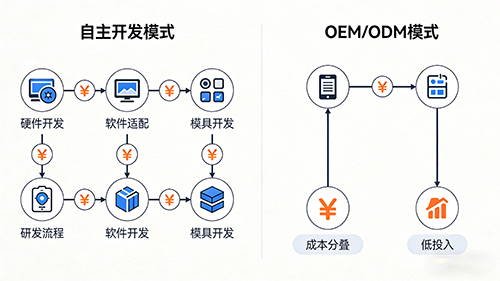
The cost pressure of independent development permeates the entire process, creating formidable financial barriers. From initial hardware R&D and software adaptation to mold creation and supply chain setup, the brand bears the full brunt of investment. Core hardware R&D and testing alone can cost millions. When added to hidden costs like team recruitment and lab construction, the upfront capital becomes a prohibitive threshold for many. Furthermore, limited production volumes in the early stages weaken bargaining power for components, driving up unit costs and creating a vicious cycle of “High Investment → Low Volume → High Cost.”
The OEM/ODM model offers an optimal solution through resource sharing. ODM manufacturers leverage mature public mold designs, spreading R&D costs across multiple partner brands. Brands avoid basic R&D expenses, paying only for minor customizations, which can reduce upfront investment to one-tenth (or less) of independent development. On the supply chain side, contract manufacturers utilize economies of scale to procure components at lower prices and employ lean production processes to minimize waste, driving unit costs to industry lows. This “R&D Cost Sharing + Supply Chain Consolidation” model allows brands to launch projects with lightweight capital, focusing their resources on marketing and brand building.
⚡ 2. Time Cycle: From Lengthy Polishing to Rapid Deployment
The end-to-end cycle for independent development often spans 6 to 12 months or longer. Every stage—from project initiation and R&D to prototyping, mold making, and mass production tuning—is susceptible to delays caused by technical bottlenecks or supply chain issues. Critical phases like hardware-software integration and compatibility testing require repeated iterations, Easily causing brands to miss key market windows. By the time the product launches, market demands may have shifted, rendering the heavy upfront investment misaligned with reality.
The OEM/ODM model accelerates time-to-market through “Front-Loaded R&D.” ODM partners have already completed core technology development and product validation, maintaining a library of mature solutions. Brands only need to perform minor aesthetic tweaks or software customizations on existing frameworks, slashing the cycle down to 1–3 months. Moreover, the manufacturer’s supply chain is highly synchronized; component procurement, production scheduling, and quality assurance follow standardized workflows, eliminating the need for brand-side coordination. This “Ready-Made Solution + Rapid Customization” approach enables brands to respond instantly to market trends, launching products during demand surges to seize the first-mover advantage.
🛡️ 3. Risk Management: From Full-Chain Burden to Professional Distribution
Under the independent development model, the brand bears all risks alone. Technically, they face unknowns in hardware compatibility and software stability; design flaws can lead to costly recalls. Market-wise, long development cycles increase the risk of product-market mismatch and inventory backlog. Supply chain-wise, price volatility or component shortages can stall projects, forcing brands to build redundant supply chains at extra cost.
The OEM/ODM model distributes these risks through professional specialization:
- Technical Risk: Mature solutions from manufacturers are market-proven, avoiding most design flaws. The manufacturer assumes responsibility for technical rectifications.
- Supply Chain Risk: Manufacturers, serving multiple clients with stable channels, can better withstand component shortages or price fluctuations, ensuring delivery stability.
- Market Risk: Rapid deployment allows brands to conduct small-batch pilot runs to validate the market. Strategies can be adjusted based on feedback before committing to large-scale production, minimizing the impact of potential failures.
This “Professional Teams Absorb Risk” model significantly reduces operational uncertainty for brands.
🤝 Conclusion: Efficiency Innovation Behind Model Transformation
The core value of the OEM/ODM model lies in restructuring the industrial division of labor, freeing brands from the heavy assets of R&D and production so they can focus on building core competencies. It is not merely “contract manufacturing”; it is a systemic solution for resource integration and efficiency optimization. By sharing R&D costs, it lowers entry barriers; through standardized processes, it shortens time-to-market; and via professional specialization, it disperses operational risks.
In an increasingly competitive landscape, this model provides a shortcut for brands to enter the market quickly, making it ideal for startups or enterprises testing new waters. As supply chain collaboration capabilities continue to evolve, the OEM/ODM model will remain the central engine for cost reduction and efficiency gains in the tablet industry, driving win-win development for both brands and the broader ecosystem.
Leave a Reply